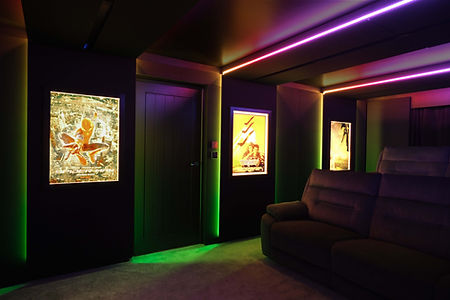
Managing Room Acoustics in Home Cinema: Achieving Balance and Clarity

Updated: Dec 19, 2025

When creating a home cinema or media room, most people focus on the equipment — the projector, speakers, and amplifiers — but overlook one of the most critical components: the room itself. The sound you hear isn’t produced by the loudspeakers alone; it’s the result of the interaction between the speakers and the room’s acoustics. Even the best speakers and amplifiers will fall short in a poorly designed acoustic environment.
That’s why room design must be considered an integral part of any home cinema installation.
Why Room Acoustics Matter
In an untreated space, sound reflections between parallel walls cause flutter echoes, while low-frequency energy builds up in corners and along surfaces, creating boomy or uneven bass. These reflections smear detail, reduce clarity, and make dialogue harder to understand — especially in immersive, multi-channel systems like Dolby Atmos, where precise sound placement is essential.
An acoustically uncontrolled room can make a high-end system sound confused and fatiguing rather than natural and engaging.
The Problem with Over-Absorption
Many people try to solve these problems by adding absorbent materials throughout the room. While absorption can help, too much of it creates an overly “dead” or lifeless sound. Thin foam panels or soft furnishings tend to absorb high frequencies but do little to control low-frequency energy, leaving the room unbalanced and oppressive.
Over-damping also feels unnatural. As humans, we’re subconsciously tuned to recognise the reflections that help us understand space and distance. Removing all of this information robs the room of its character and realism and can leave us feeling uneasy.
The Science Behind Balanced Acoustics
Experts like Dr. Floyd Toole, a leading researcher in loudspeaker and room interaction, emphasise that great sound is about balance — a thoughtful mix of absorption, diffusion, and reflection. A well-designed room maintains detail, clarity, and spatial cues without unwanted echoes or an over-damped, clinical sound.
In short, the goal is not to eliminate reflections but to manage them intelligently.
Designing for Diffusion and Control
The answer lies in creating a diffuse, balanced acoustic environment — one that breaks up sound waves across a wide range of frequencies. This approach keeps the room lively while preventing sound from ringing or reverberating excessively.
At Sonic Vision, we use timber-frame and clip-on CNC acoustic panels to achieve this. The framework and panels create a diffusive surface structure that effectively scatters sound energy, controlling reflections while maintaining warmth and clarity.
This technique breaks up reflected sound energy, bringing it to a level that allows absorption to be effectively handled with soft furnishings and finishes, resulting in a natural, enveloping media experience. The modular design also provides flexibility, durability, and aesthetic integration — ideal for both dedicated cinema rooms and multi-purpose living spaces.
Conclusion
Effective room acoustic management is essential for achieving balance, clarity, and emotional impact in your home cinema. By treating the room as part of the system — not an afterthought — you can ensure every movie, concert, or game sounds as it was meant to be heard.
At Sonic Vision, our team combines acoustic science, architectural design, and advanced installation techniques to create home cinemas that perform as beautifully as they look.

We are audio visual specialists who have been delivering luxury technology solutions for residential spaces in the UK since 2010.
Find out more about our range of home services and recent projects.


